
Traditional vs. Digital Ground Systems: What’s Changing and Why It Matters
Previously, we shared the technical side of Digital IF and how digitized signals move through modern SATCOM networks in our Digital IF Explained post.
Rather than focusing on the technical side, this article is about the operational shift happening across satellite ground systems and why more organizations are moving away from traditional hardware-heavy architectures toward digital, software-defined infrastructure.
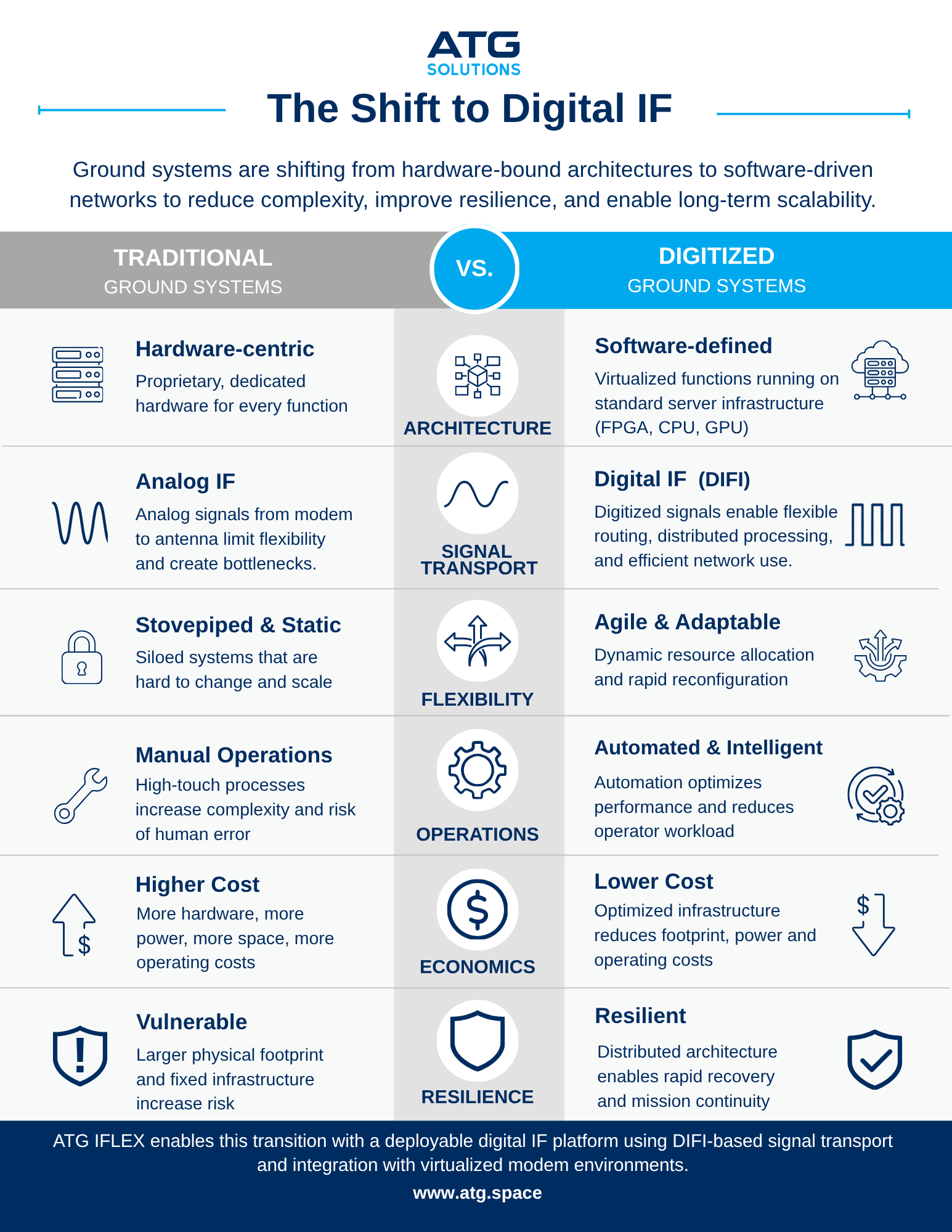
The infographic accompanying this article compares the two approaches side by side. Here’s what those differences look like in practice.
Architecture: Hardware-Centric vs. Software-Defined
Traditional ground systems were built around dedicated hardware. Every major function in the signal chain relied on its own physical device, including modems, converters, switches, processors, and monitoring equipment.
That approach worked for years, but it also created systems that became increasingly difficult to scale and maintain over time. Expanding capability usually meant adding more hardware, more rack space, more integration work, and more vendor dependencies.
Digital ground systems change that model.
Instead of relying entirely on dedicated hardware, many functions now run as software on standard server infrastructure using CPUs, GPUs, and FPGAs. That allows operators to deploy updates faster, scale more efficiently, and adapt systems without rebuilding large portions of the architecture.
The result is a more flexible ground environment that is easier to manage as mission requirements evolve.
Signal Transport: Analog IF vs. Digital IF
One of the biggest changes is how signals move through the ground system.
Traditional architectures rely heavily on analog IF connections between equipment. Those signal paths are tied to physical hardware layouts, which can make systems harder to expand and less flexible operationally.
Digital IF changes that by transporting signals digitally over standard networks.
That creates a more flexible environment where signals can be routed, shared, and processed across distributed systems without the physical limitations that analog infrastructure introduces.
Operationally, that means:
- Easier scaling
- More flexible routing
- Better use of compute resources
- Simpler integration across systems and sites
This is one of the key drivers behind the industry’s shift toward digitized architectures.
Flexibility: Stovepiped vs. Agile
Traditional systems are typically designed around a fixed mission set. Supporting new satellites, changing frequencies, or expanding operations often requires hardware upgrades and significant integration work.
That process can be slow and expensive.
Digital systems are far more adaptable because software-based infrastructure can be reconfigured much more quickly than hardware-based systems.
As satellite operations continue evolving, that flexibility becomes increasingly important. Operators need infrastructure that can support changing requirements without forcing major redesigns every time missions expand or priorities shift.
Operations: Manual vs. Automated
Traditional ground systems require significant manual oversight. Operators are responsible for monitoring hardware, troubleshooting equipm
- ent, managing configurations, and handling routine operational tasks across multiple systems. As networks grow, operational complexity grows with them.
Digital systems reduce much of that burden through automation and centralized management. Software can continuously monitor system health, allocate resources dynamically, and identify problems before they affect operations. That helps reduce:
- Manual workload
- Human error
- Staffing demands
- Operational complexity
For organizations managing distributed SATCOM environments, automation is becoming increasingly important for long-term scalability.
Economics: Higher Cost vs. Lower Cost
Traditional systems require large physical infrastructure footprints along with the power, cooling, maintenance, and facility support needed to sustain them. As systems grow, those costs grow too.
Digital architectures reduce much of that overhead by consolidating functions into software-driven compute environm
ents. That leads to:
- Smaller footprints
- Lower power consumption
- Reduced cooling requirements
- Simplified maintenance
- More efficient long-term scaling
The difference is not just about reducing hardware. It is about reducing the operational burden that comes with maintaining hardware-heavy infrastructure over time.
Resilience: Vulnerable vs. Resilient
In traditional architectures, specific functions depend on specific pieces of hardware. When those components fail, outages can follow until repairs or replacements are made.
Digital systems handle resilience differently.
Because workloads are software-based, processing can shift between available compute resources more easily when failures occur. That improves continuity and allows systems to recover faster without relying entirely on duplicate hardware chains.
As satellite operations become more distributed and mission-critical, resilience becomes a much larger part of infrastructure planning.
IFLEX-D and the Transition to Digital Ground Systems
For many operators, the move to digital ground infrastructure does not happen all at once. Existing RF systems, analog workflows, and fixed hardware environments still play a major role in day-to-day operations.
That is where ATG’s IFLEX-D fits.
IFLEX-D serves as a practical bridge between traditional SATCOM infrastructure and modern Digital IF architectures by digitizing RF signals and enabling DIFI-based transport across standard IP networks.
Rather than requiring a complete infrastructure replacement, IFLEX-D allows operators to begin modernizing incrementally, reducing dependence on rigid hardware chains while creating a foundation for more flexible, software-defined, and distributed ground operations over time.


Comments are closed